
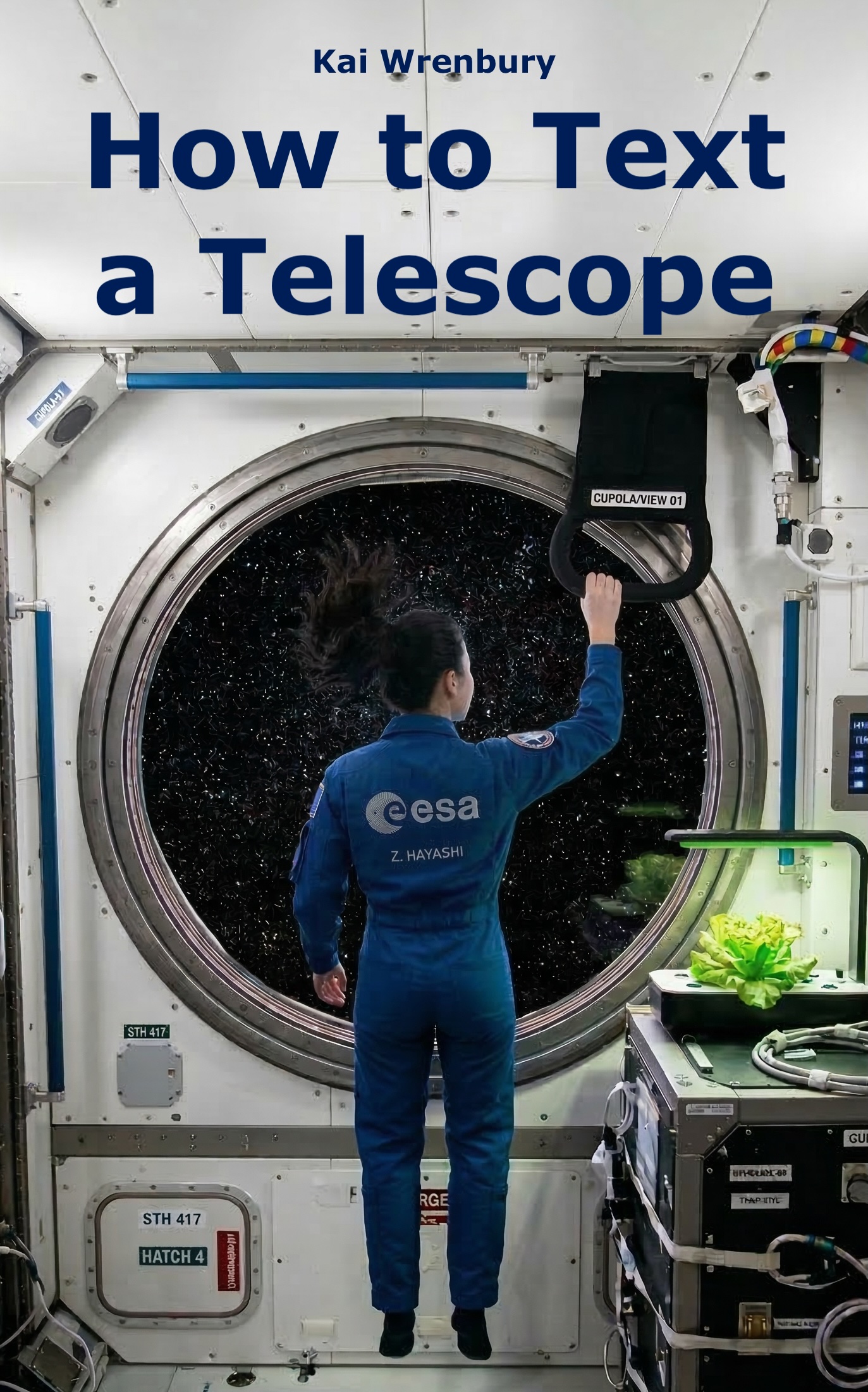
Hard science fiction
How to Text a Telescope
by Kai Wrenbury
Dr. Zara Hayashi went back for a laptop during an emergency evacuation of a deep-space research station. It held eight months of her grandmother's messages — video calls, audio, photographs of the Kobe garden. A secondary pressure excursion triggered automatic departure while she was still inside. Now she is the sole occupant of ELARA Station at Sun-Earth L2, 1.5 million kilometres from the nearest other human being.
This is Book One. Zara's story continues in Book Two, now on its way.
What kind of book is this
Dr. Zara Kimie Hayashi is a Senior Systems Engineer with the European Space Agency. She is 34 years old, 155 centimetres tall, and currently the sole occupant of a seven-module research station at Sun-Earth L2. Her parents died in a car accident five years ago. Her grandmother — her last living relative — died six weeks before the mission anomaly. The laptop she went back for holds the last eight months of their ordinary traffic: short video calls, audio messages, photographs of the Kobe garden, recipes held up to the camera because her grandmother never trusted attachments.
The primary antenna is destroyed. The three secondary Ka-band patches are transmitting, but a damaged reference path smears the beam across a patch of sky several beam-widths wide. Ground can see the station is occupied. They cannot read her messages. She transmits her name, and it arrives as fragments.
Food: 311 days' worth. Water: stable. Power: easy. Propellant for station-keeping: exactly five burns. She needs five burns. The rescue timeline is somewhere between seven and ten weeks, and the margin is not a margin — it is an exact balance between what she has and what she needs, and exact balances don't stay balanced.
Setting
ELARA Station — seven pressurised modules at Sun-Earth L2, designed for eight crew. A centrifuge nobody commissioned. An AI nobody can power. A bonsai somebody left behind.
Tone
Technical, dry, gently funny. She changes the thermostat to 23°C and logs it as the first improvement. She names the lettuce Keiko and writes a README for it.
Structure
Zara's log entries alternate with chapters at ESOC Darmstadt, where the ground team can see her station is occupied but cannot read a word she sends.
From the Void Diaries
During scheduled DSN gaps — the hours when no ground antenna is allocated and no one on Earth is listening — Zara records private video entries she calls the Void Diaries. They are not mission logs. They are not meant for broadcast. They are the things she says when the communication link goes quiet and the only audience is the station itself.
Some of them are addressed to specific people. Some of them are addressed to no one. All of them are honest in the way that only total privacy and 1.5 million kilometres of empty space can make a person honest.
I grew lettuce up here. I know you're going to ask whether I grew proper lettuce — by your standards, which are: did the lettuce grow in soil, did the lettuce grow in sunlight, did the lettuce receive properly composted fertiliser and not whatever shortcuts the hydroponics literature recommends — and the answer to all three is no, and the lettuce is fine, and her name is Keiko, and I'm not apologising.
I wrote a README for her. A document called README-KEIKO.md, with care instructions — watering schedule, light cycle, pH range, nutrient concentration targets, and a note that reads "She responds well to being talked to. I have no evidence for this. I have extensive anecdotal data."
The Void Diaries are where the novel's emotional centre lives. The research holds up the setting. The procedures hold up the plot. But the diaries are where Zara stops being an engineer solving problems and becomes a person trying to stay whole while solving them.
Why I wrote this
I wanted more hard science fiction books, the ones that will not annoy me with obvious mistakes. I have no need for big drama, I never enjoyed "fighting agains the big evil" stories. Needed something that's not boring, but gentle and mildly funny, slice of life with things happening.
Long-distance running made me run out (pun intended) of these audiobooks. Also, it's important to have take-away, characters that you can relate to, look up to. Pacing matters. Restraint matters. What you can still do when you are tired matters. That is the kind of resilience I wanted in the book.
As Kai Wrenbury I can scratch this itch, create what I miss and share it with others. The pen name allows me to explore these ideas freely, without constraints.
The person behind the pen name comes out of a long stretch in software, with engineering degrees, too many languages, and the habits that go with that. I like systems that stay legible under pressure. I am comfortable close to the machine. Opening a hex editor to figure something out does not feel exotic to me. It feels normal.
The research behind the book turned into its own set of journal entries — orbital mechanics, halo orbits at L2, life-support cycling at low crew load, Orion avionics and fault containment, EVA procedure, communication delay over 1.5 million kilometres, and the question of what kind of AI system an ECSS certification board would actually approve.
Read the research journalReady to start reading?
Available on Kindle worldwide. Or read the first half free — you'll know by the propellant numbers whether you're staying.
Visit the full site